Getting Started With A Blank Unit Circle For Beginners - GameDay Database Information Guide
Overview to Getting Started With A Blank Unit Circle For Beginners - GameDay Database

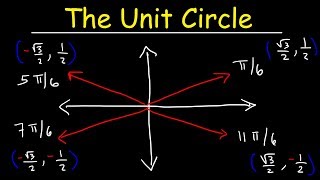
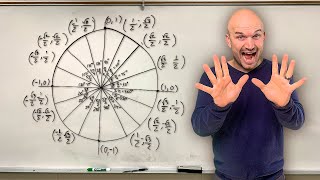
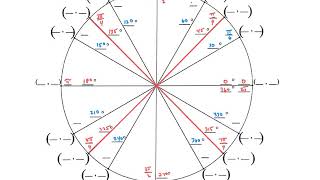
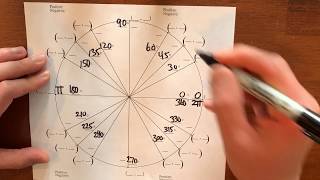
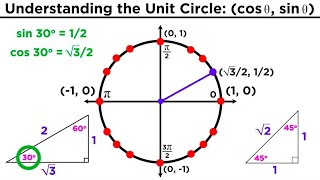
I know- the music is awful! I have a music-free, BETTER version of this video here: This is the best, ... SAT and ACT prep precalculus and trig the fastest method to complete the This is the thing that has kept you up at night all week! That darn For individuals new to geometry and trigonometry, understanding the unit circle is a crucial step in mastering these mathematical concepts. Getting Started with a Blank Unit Circle for Beginners is an essential topic that can seem daunting at first, but with the right approach, it can be a straightforward and engaging learning experience. The unit circle, a fundamental component in mathematics, is a circle with a radius of 1 centered at the origin of a coordinate plane. It is used to define the basic trigonometric. The unit circle is defined by its equation $x^2 + y^2 = 1$, where $x$ and $y$ are the coordinates of any point on the circle. This definition implies that every point on the unit circle is exactly 1 unit away from the origin, which is the center of the circle. To get started with a blank unit circle, beginners should first understand how the circle is divided into four quadrants and how angles are measured in a counterclockwise direction from the positive x-axis. This foundational knowledge is critical for further. One of the primary uses of the unit circle is in defining the sine, cosine, and tangent of an angle. These trigonometric functions are essential in physics, engineering, and other fields where the relationships between the sides and angles of triangles need to be understood. For beginners, it's important to recognize that the unit circle serves as a tool for visualizing and calculating these relationships. By understanding how the coordinates of points on the unit circle relate to the values of sine and cosine.
For those looking to get started with a blank unit circle, several learning strategies can be particularly effective. Firstly, visualizing the unit circle and its properties can help in memorizing key angles and their corresponding trigonometric values. Utilizing diagrams and graphs, such as those found in educational resources or generated using mathematical software, can facilitate this process. Secondly, practicing problems that involve identifying points on the unit circle and calculating trigonometric. In conclusion, getting started with a blank unit circle is an accessible and rewarding experience for beginners. By grasping the fundamental principles of the unit circle and its role in trigonometry, individuals can set themselves up for success in a wide range of mathematical and scientific pursuits. As learners progress in their understanding and application of the unit circle, they will find that it opens doors to more advanced concepts and exciting areas of study, from calculus and geometry to physics and. Take it from me, if you want to be more efficient at solving trig equations both in precalculus and calculus, you need to know the ...
Important Facts

History



Detailed Analysis
Data is compiled from public records and verified media reports.
Last Updated: August 24, 2026
Conclusion
Disclaimer: Disclaimer: All {Player Profile|Athlete Statistics|Sports Record|Performance Profile|Match Statistics|Sports Database} information, player statistics, rankings, and performance data are compiled from publicly available sports databases, official league records, and trusted third-party sources.
